

Gillian McKnight
Senior Associate
Gillian is one of Trilby Misso’s Compensation Expert’s.
Meet GillianEarly in my career it was common to receive enquiries from nurses, support workers and other residential home carers who had been injured as a result of their work. The injuries were often quite severe – usually involving significant back and shoulder injuries – and would regularly require extensive time off work and treatment.
Importantly at that time, these injuries would often stem from what we would consider now to be quite obvious unsafe practices: unsafe manual lifts, one-staff manoeuvres on immobile clients, and very little mechanical aides. As more and more claims went through and were successful, we saw a shift in employers’ attitudes towards safety. Hoists became common place; two-person assists for certain activities became mandatory; slide-sheets for dressing and changing bedding became standard. The instance of injuries (and therefore claims) reduced, and the arguments for negligence became more nuanced. These widespread industry changes were possible as most care was being provided in residential care facilities and nursing homes by a few large businesses.
The introduction of the NDIS and its rollout in 2019, as well as a larger uptake of the My Aged Care program (soon to be known as Support At Home), saw a widespread shift in how assistance was provided to individuals. Instead of relying on larger corporations providing assistance in company-operated premises, those needing support were able to engage in assistance directly with a care provider or with niche agencies, driving smaller and more varied operations throughout the state.
With this has come a familiar source of enquiries: support workers calling with significant injuries stemming from unsafe lifting practices, unreasonable solo manoeuvres, and inadequate consideration of safe systems of work.
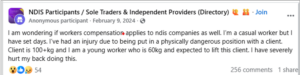
An example of what is being expected of NDIS support workers, and the types of injuries and claims we are seeing again as a result.
Increase in WorkCover claims – a result of the NDIS?
In comparing the claims by sub-industry detailed in Queensland Government’s Workers’ Compensation Scheme Statistic reports[i] it is clear that this is more than just a sense of de ja vu.
Claims listed under the sub-type of ‘residential care services’ in 2019 (the year prior to the NDIS rollout) totalled 3259. The claims in 2024 were 3496, so a variation of 237 more claims or an increase of just 6.7%. Injuries in the ‘hospital’ sub-type remained steady: the 2019 year saw 5466 claims, while the 2024 year saw only 5462. This appears consistent with the understanding that these sub-types involve larger scale employers with more controlled settings.
The numbers within industry sub-types involved with the NDIS are a very different story. In 2019, claims totalled 3054 for ‘social assistance services’. This was an increase of only 103 claims on the previous financial year. By 2024 there had been a total number of 4796 claims, representing a 36% increase compared to the pre-NDIS era.
Importantly, these figures only account for WorkCover claims and therefore only workers employed by the agency providing support. There are likely to be a further number of injured workers who are contracted under their own ABNs and therefore not eligible to claim statutory benefits.
Non-delegable duties and the responsibility of NDIS-recipients
Since this shift, I have had enquiries from claimants who allege that they were recruited and placed by an agency without meeting with the claimant, without performing any inspection of the NDIS-recipient’s premises and without any consideration or adaptation for a safe system or method of working. Some instances have involved the claimant raising concerns about safety due to a lack of suitable equipment, or in some cases broken equipment that should be replaced to be safe, and these concerns not being addressed.
It is well established that an employer has a non-delegable duty to its employees. It appears these employers have taken an ‘arms-length’ approach and put the financial implications are prioritised over the safety of the worker, likely not understanding their non-delegable duty to their employee. In most of the instances above it is likely that negligence will be established through the lack of reasonable steps to ensure that the safety of the worker has been considered, and an appropriate system of work implemented.
Where the potential complication lies is in the recipient’s involvement. One could reasonably argue that if the recipient is engaging an agency to provide and perform services from them, that they are also entitled to rely on the agency to ensure that the provision and performance of those duties are done to a safe standard.
Whether this fully absolves them from legal responsibility is unclear – much like a labour hire and a host, it may come down to the individual circumstances of each case to determine whether any apportionment is suitable. Where a recipient is engaging the employer to evaluate their needs and provide services accordingly, then liability is likely to rest solely on the employer. This situation is likely to be complicated however if the employer is only responsible for the provision of services and the recipient, or another provider engaged by the recipient, is responsible for mechanical aides, equipment maintenance and repairs.
Future impacts
While I would like to imagine that the increase in claims will result in larger improvements in safety throughout the industry as we had seen previously, I anticipate that what we are more likely to see initially is a shift by agencies to engage self-employed contractors as opposed to hiring them as employees.
In considering coverage for workplace injuries in the ‘gig economy’, the Queensland Office of Industrial Relations[ii] noted it was difficult to state specifically the number of ‘gig’ workers, but referred to the Commonwealth Government’s Closing Loopholes Bill that estimated 16,300 workers performing care work such as aged care and NDIS support services. The report also listed direct service support worker apps Hireup and Mable as notable digital platforms along with Doordash, Uber and Ola.
For these workers previously, their coverage by WorkCover was dependant on them obtaining their own Workplace Personal Injury Insurance policy. Importantly, this policy does not extend to common law rights, as the person is still considered a self-employed entity and not an employee or worker.
This gap has the potential to be covered by the recent legislative amendments regarding ‘gig’ workers. Amendments to the Workers Compensation and Rehabilitation Act 2003 in September 2024 expanded the definition of worker to include gig workers under certain circumstances. Section 11(1) of the Act now states a worker is:
(a) a person who—
(i) works under a contract; and
(ii) in relation to the work, is an employee for the purpose of assessment of PAYG withholding under the Taxation Administration Act 1953 (Cwlth), schedule 1, chapter 2, part 2-5; or
(b) a person who is a regulated worker under the Fair Work Act 2009 (Cwlth) if—
(i)a minimum standards order, minimum standards guideline or collective agreement applies to, or covers, the person under chapter 3A of that Act; and
(ii)the person is prescribed by regulation to be a worker.
So far, the applications for minimum standards orders/guidelines with the Fair Work Commission as detailed on their website have been focussed on road transport workers including rideshare operators. An application brought by the Transport Workers Union on behalf of transport workers is due to be heard in December.
The relevant union for support and NDIS workers is the Australian Services Union (ASU). It appears that the ASU to date has made a Fair Work application to review workers classifications and pay rates[iii] however do not appear to have yet applied for a minimum standards order or guidelines to be implemented. Hopefully this is on their agenda, and the Queensland Government will provide the necessary regulation to ensure these workers have appropriate coverage and access to common law damages.
The rise in injuries among NDIS and in-home aged care support workers reflects a system where safety considerations for workers have not kept pace with structural change, particularly as responsibility for providing recipients with care has become more diffuse. Further action is required to ensure that those workers that were considered as part of the reasoning for the Workers Compensation and Rehabilitation Act 2003 amendments are effectively covered.
Only then are we likely to once again see a claims-driven shift in industry culture towards ensuring the safety of workers over the profit of providers.
Gillian McKnight
Senior Associate – Trilby Misso Lawyers
[i] Queensland Government, Queensland workers’ compensation scheme statistics 2018-2019 (p55), Queensland workers’ compensation scheme statistics 2019-2020 (p56) and Queensland workers’ compensation scheme statistics 2023-2024 (p57),
[ii] Queensland Government Office of Industrial Relations, Decision Impact Analysis Statement – Gig workers and bailee taxi and limousine drivers (p14-15):
[iii] Australian Services Union, Undervalued and overworked: Australian Services Union calls for recognition of NDIS Workers — Australian Services Union – The Union for NDIS Workers

Use this simple online tool and find out if you have a claim in less than thirty seconds. You can choose to remain anonymous.
Your next step is a small one. All you need to do is give us a call on 07 3910 5470 or complete this form here to arrange a quick chat.
During this initial conversation, we will:
We understand that taking legal action can be stressful, and we’ll do all we can to ease your concerns.
The chat can take place at our place, your place, or by phone. There is no cost, no pressure, and no obligation.
Call 07 3910 5470 or fill out this form, and we’ll get back to you within 2 hours (during business hours). We look forward to meeting you.
enquire now


