
What You Can Claim After a Car Accident
Most people assume a car accident claim is about the car. It is not. A claim in Queensland is about what the accident did to you and to the life you were living before it, and the law recognises several distinct categories of loss. A properly run claim accounts for all of them, which is why an early offer from an insurer so often falls short.
Medical and rehabilitation costs
This covers the treatment you have already had and the treatment you will need: ambulance and hospital costs, GP and specialist appointments, surgery, physiotherapy, psychology, medication, scans, and equipment or home modifications if your injuries call for them.
The part that gets underestimated is the future. An injury that will need a knee reconstruction in eight years’ time belongs in your claim now, because once a claim settles it is settled for good. There is no second bite.
Lost income and lost earning capacity
If you have missed work, you can claim the wages you did not earn. If your injuries mean you will never again earn what you used to, that is a separate and usually much larger head of damage called loss of future earning capacity.
This is where a rushed claim becomes expensive. A concreter with a permanent shoulder injury at 38 is not simply out of pocket for the twelve weeks he could not work. He faces a different working life, probably a shorter one and certainly a lower paid one, measured across decades.
Pain and suffering
Queensland calls this general damages, and it compensates you for the pain, the loss of enjoyment of life and the things you can no longer do. It is calculated using an Injury Scale Value, a scale from 0 to 100 prescribed by the Civil Liability Regulation 2014 and based on the nature and severity of your injuries.
Because the scale is fixed, the argument is never about the maths. It is about where on that scale your injuries properly sit, and that is decided on medical evidence, which is a large part of what your lawyer is actually for.
Care and assistance
If you have needed help with things you used to manage on your own, whether that is showering and dressing, driving the kids around, mowing the lawn or doing the shopping, that help has a value even when your partner or your mum provides it free.
People leave this out because it does not feel like a cost. It is one of the most commonly overlooked entitlements in Queensland personal injury law, and in a serious claim it is substantial if it meets the threshold.
Out of pocket expenses and legal costs
Travel to appointments, hospital parking, prescriptions, and the incidental costs that accumulate quietly over a year of treatment. Keep your receipts, because they all count. A portion of your legal costs is generally recoverable in the settlement too.
One thing CTP does not cover
Queensland’s CTP scheme covers personal injury. It does not cover damage to your vehicle or property, and it does not cover the injuries of the driver who caused the accident. Vehicle damage is a matter for your comprehensive or third party property insurer, on a separate track to your injury claim.
CTP Claims: How They Actually Work in Queensland
Here is the single most important thing to understand, and the thing that stops a great many people from ever making a claim they were entitled to make.
You are not being paid by the other driver. You are claiming against the other party’s insurer.
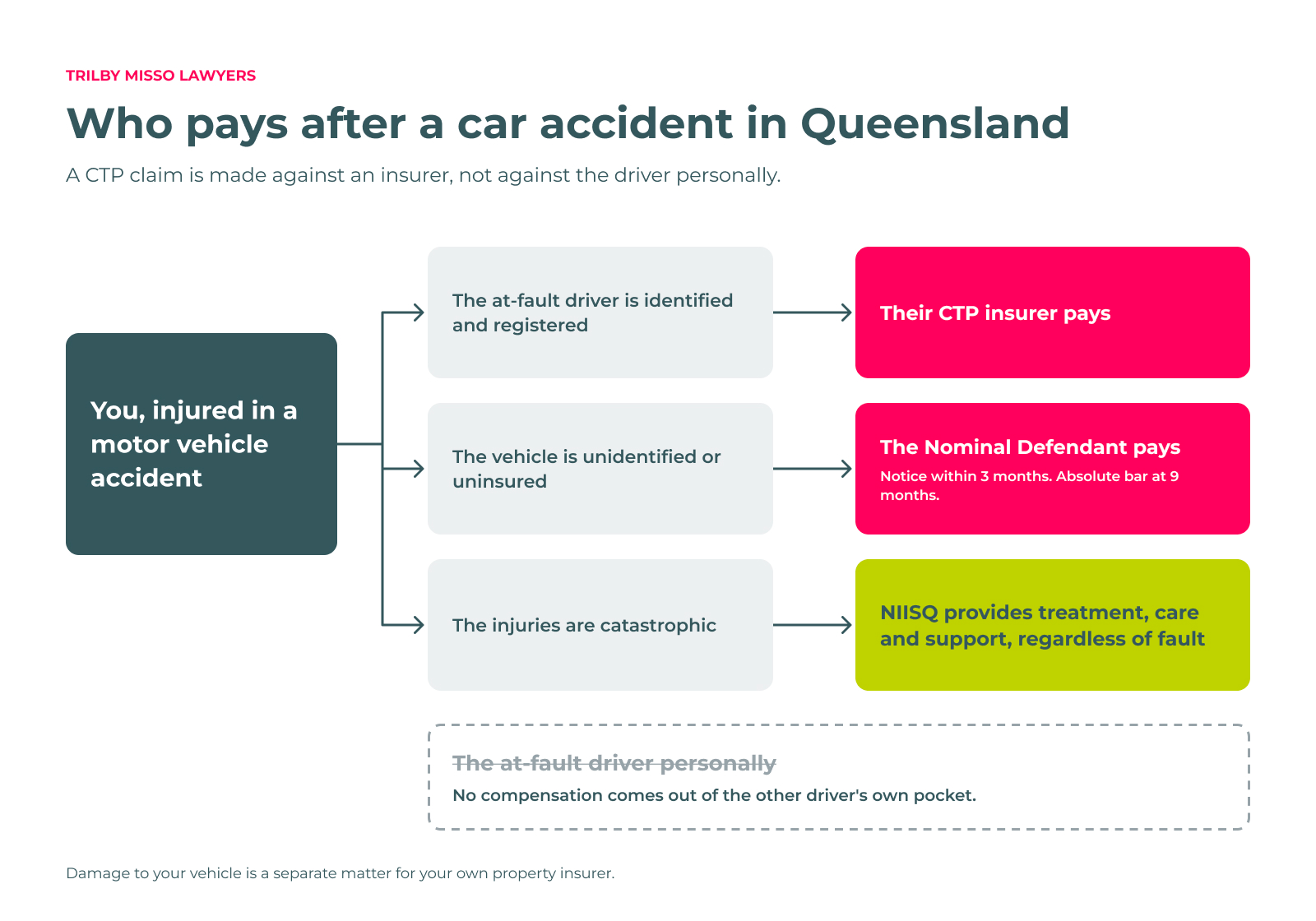
Every registered vehicle in Queensland carries compulsory third party insurance as part of its registration, and the scheme is overseen by the Motor Accident Insurance Commission. That is what the CTP component of your rego bill is. Its entire purpose is to cover people who are injured when the driver of that vehicle is at fault. So when you lodge a claim, the money does not come out of the other driver’s pocket, their savings or their house. It comes from an insurance policy that exists for exactly this situation, and that they have already paid for.
This matters enormously in real life, because so many Queensland accidents involve someone the injured person knows. Your mate was behind the wheel on the way home from the footy, or your husband misjudged a wet roundabout with you in the passenger seat. People sit on legitimate claims for years rather than act against someone they love, and in almost every one of those cases nobody they love is out a cent.
If the vehicle that hit you cannot be identified, as in a hit and run, or it turns out to be unregistered and therefore uninsured, you are not shut out either. Your claim is made against the Nominal Defendant, a body that stands in the place of the missing insurer. Those deadlines are much shorter, so they need to be acted on quickly.
For a deeper explanation of the scheme, see our page on CTP claims and CTP lawyers. If you are unsure which type of claim you have, start with our overview of accidents on the road.
Who Can Claim: Drivers, Passengers, Pedestrians, Cyclists and Motorcyclists
The scheme is broader than most people expect. If a motor vehicle was involved and someone else’s negligence caused your injuries, your entitlement generally does not depend on whether you were behind a wheel at the time.
If you were driving
If another driver caused the accident, you claim against their CTP insurer, and our page for people who were a driver in a car accident covers this in more detail. If you were entirely at fault you cannot claim under CTP for your own injuries, although you may still have cover through income protection, total and permanent disability insurance inside your super, or NIISQ if the injuries are catastrophic.
If you were driving for work, you may have both a CTP claim and a WorkCover claim running at once, and the two need co-ordinating rather than running separately.
If fault was shared, you can still claim. Contributory negligence reduces your compensation by the percentage you were responsible for rather than wiping it out, so a claim assessed at 25 per cent contributory negligence still pays 75 per cent. Do not let an insurer’s early suggestion that you were partly to blame talk you out of advice.
If you were a passenger
Passengers are in the strongest position of anyone involved, because a passenger is almost never at fault. It does not matter whether the driver of your car or the driver of the other car caused it. One of them has a CTP insurer, and that is who your claim is against, whether you were in a mate’s car, a family member’s car, a taxi, an Uber, a bus or a work vehicle. There is more on our page for passengers injured in a car accident.
If you were a pedestrian or a cyclist
You do not need to be in a vehicle to claim under CTP. You need a motor vehicle to have been involved. Pedestrians struck at crossings and intersections, and cyclists hit by cars or doored by a parked driver, have the same entitlements.
These claims often involve serious injuries, because there is nothing between a person and the road, and they are frequently fought hard on liability. Evidence gathered early, including CCTV, dashcam footage and witness details, usually decides them.
If you were riding a motorcycle, an eBike or an eScooter
Motorcyclists are heavily over-represented in serious injury statistics, and they are also over-represented among people wrongly assumed to be at fault. A rider who was lane filtering legally, or who was struck by a driver turning across their path, has the same entitlement as anyone else.
eBike and eScooter injuries are newer and messier, because whether CTP responds depends on the device and on whether a registered motor vehicle was involved. If a car hit you while you were riding one, it is worth a phone call. The same goes for truck and heavy vehicle accidents, which involve more serious injuries and more parties.
Catastrophic injuries and NIISQ
Where injuries are catastrophic, meaning permanent spinal cord injury, severe traumatic brain injury, major burns, multiple amputations or permanent blindness, the National Injury Insurance Scheme Queensland may also apply. NIISQ is a no-fault scheme covering accidents from 1 July 2016, so it provides treatment, care and support regardless of who caused the accident, including where the injured person was at fault. The scheme publishes its eligibility criteria in full.
NIISQ and a CTP claim can run alongside each other, so get advice early. The two schemes interact and the sequencing matters.
Time Limits for Car Accident Claims in Queensland
Of everything on this page, this is the section to read twice. Queensland’s time limits are tighter than most people assume, and missing them can end a perfectly good claim permanently.
The 9 month rule
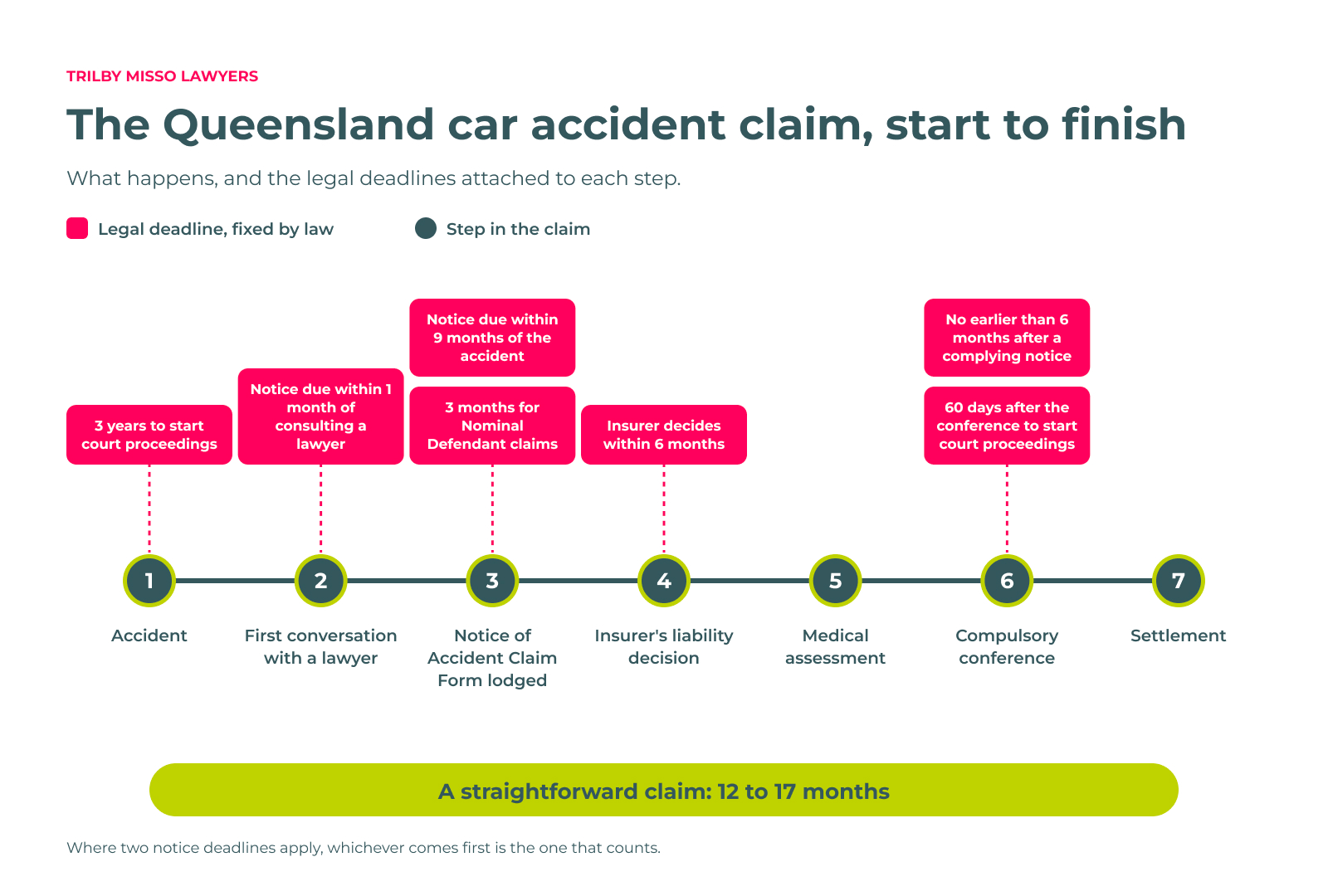
You must give a Notice of Accident Claim Form to the relevant CTP insurer within 9 months of the accident, or within 9 months of the date your symptoms first appeared if they came on later.
The 1 month rule that catches people out
This is the one almost nobody knows about. If you consult a lawyer about the possibility of making a claim, the notice must be given within 1 month of that consultation, even if the 9 months has not run out.
Section 37 of the Motor Accident Insurance Act 1994 requires the notice by whichever of those two dates comes first. So speaking to a lawyer early does not extend your time. It can shorten it, and it puts an obligation on whoever you speak to. That is a good reason to talk to a firm that will act rather than one that will take your details and call you back next month.
Hit and run and uninsured vehicles
Where the vehicle is unidentified or uninsured, your claim goes to the Nominal Defendant and the clock is much shorter. Notice should be given within 3 months of the accident. If notice is not given within 9 months of the accident, the claim against the Nominal Defendant is barred outright, and there is no discretion to fix it.
The 3 year court deadline
Separately, court proceedings must generally be started within 3 years of the accident. Most claims settle long before court, but the limitation period runs in the background regardless and governs the whole timetable.
What if you are already late
Being outside a deadline is not automatically the end of it. Where notice is given late, the obligation to give it continues and you must provide a reasonable excuse for the delay, which the insurer assesses. The 9 month Nominal Defendant bar and the 3 year CTP claim time limit is the hard exception.
So if the accident was eight months ago, or fourteen, do not assume you have missed your chance. One phone call gets you a straight answer, and the alternative is never knowing.
How a Car Accident Claim Works, Step by Step
Nobody has done this before, and the uncertainty is a big part of what makes it stressful. Here is the process from the first phone call to the money landing.
1. The first conversation
We talk about what happened, what injuries you have and how it has affected your work and your life, then give you an honest view of whether you have a claim. It is free, there is no obligation, and it can happen at our office, at your place or over the phone.
2. Getting the claim on foot
We identify the correct CTP insurer, prepare your Notice of Accident Claim Form and lodge it within time. We also start gathering the evidence that matters later: the police report, medical records, witness statements, and any CCTV or dashcam footage before it is overwritten.
3. The insurer investigates
Once your notice is compliant, the insurer investigates and must tell you in writing within 6 months whether it admits liability, admits it in part or denies it. If liability is admitted, the insurer must also fund reasonable rehabilitation while your claim continues, one of the most useful features of the scheme.
4. Medical assessment
You will be examined by independent medical specialists, often by specialists engaged by both sides. These reports establish the nature of your injuries, your Injury Scale Value and your prognosis.
Timing is everything. Assessing you before your condition has stabilised produces a report that understates your injury, and a settlement built on that report is one you are stuck with. Part of our job is knowing when you are ready.
5. Valuing the claim
We build the number from the ground up: past and future medical costs, past and future income loss, general damages under the ISV, care and assistance, and out of pocket expenses. This is where the gap between a lawyer’s valuation and an insurer’s opening offer becomes obvious.
6. The compulsory conference
Before anyone can go to court, Queensland law requires a compulsory conference where both sides sit down and attempt to settle. It is held once your claim is ready, generally no earlier than 6 months after your complying notice.
Most claims resolve here or shortly afterwards. If the conference does not settle it, both parties exchange mandatory final offers, which carry real costs consequences and tend to concentrate everybody’s mind.
7. Settlement, or court
If it settles, we finalise the paperwork, deal with any refunds owed to Medicare or Centrelink, and your money is paid. If it does not, proceedings must be started within 60 days of the conference. Very few claims go that far, and fewer still are decided by a judge.
How long does the whole thing take
A straightforward claim with clear liability typically resolves in around 12 to 17 months. Serious injuries take longer, because a claim cannot be properly valued until your medical position is stable, and disputed liability adds time.
Talk to a Car Accident Lawyer Today
The hardest part of this process is the first phone call, and it is the smallest step in it. You are not committing to anything and you are not signing anything.
We will talk through what happened and how you have been affected, give you an indication of whether you can claim, and explain in plain terms how our process and our fees work. Ask us anything about the timeframes and the money.
The chat can happen at our place, your place, or over the phone. We have offices right across Queensland, including our Brisbane CBD office on Edward Street. There is no cost, no pressure and no obligation.
Call 1300 730 845 or fill out the enquiry form, and we will get back to you within 2 hours during business hours. We look forward to meeting you.
About the Author
This page was written by Kathryn MacDonell, CEO at Trilby Misso Lawyers.
Kathryn began at Trilby Misso as an Article Clerk in 2001, was admitted to the Supreme Court of Queensland in 2005 and became a Principal Lawyer in 2011. She has appeared in the District Court, Supreme Court, Court of Appeal and the High Court of Australia, and has stayed focused throughout on securing compensation for injured Queenslanders.
Here’s how our ‘no win no fee’ process works:
-
We chat
 It’s a free consultation.
-
We meet
 A free detailed discussion.
-
We plan
 You say ‘go’ – we build your case.
-
We lodge
 We present
your case. -
We conclude
 We reach a settlement.
You pay nothing until you win
We’ll also provide certainty and clarity, with a fair structure that has no ‘uplift’ fee, ever. You’ll pay nothing ‘til your claim is won.
Don’t delay. Speak with Trilby Misso today.
Your next step is a small one. All you need to do is give us a call on 1300 730 845 or complete this form here to arrange a quick chat.
During this initial conversation, we will:
- Have a chat about the circumstances and nature of your injury.
- Give you an indication of your eligibility to make a claim for compensation.
- Explain, in simple terms, how our process works. We will answer
any questions you have about fees, the legal process, and anything else you’re unsure about relating to your injury.
We understand that taking legal action can be stressful, and we’ll do all we can to ease your concerns.
The chat can take place at our place, your place, or by phone. There is no cost, no pressure, and no obligation.